
Raja Jon Vurputoor Chari, 43, a graduate of the US Air Force Academy, MIT and US Naval Test Pilot School, is the only Indian-American in the list.

Like the best crowd-pleasers, Project Hail Mary makes you laugh, it makes you weep a little, it keeps you riveted and then leaves you with a big smile by the end, notes Mayur Sanap.

The Chandrayaan-2 mission has made the first-ever observation of the effects of the Sun's Coronal Mass Ejection (CME) on the Moon using its onboard scientific instruments. This observation would help understand the lunar exosphere and the impact of space weather on its surface.
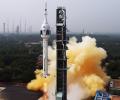
ISRO Chairman V Narayanan announces ambitious space program goals, including landing Indians on the Moon by 2040 and launching the 'Gaganyaan' mission in 2027. The agency is also working on a national space station and uncrewed missions.

The two US payloads are -Mini Synthetic Aperture Radar and Moon Mineralogy Mapper.
"It will take about five-and-half days for Chandrayaan-1 to get to the moon," officials said, adding that the probe will be in a 100 km polar orbit around the Moon.
As scientists of the Indian Space Research Organisation are decoding the data sent by Chandrayaan-1 from the moon, the space agency is confident that India's first lunar mission would reveal 'unexpected results and things'. "The data have been collected from unexplored area. We are well positioned with these data. We can tell the world that we have found many things, which no explorer has seen so far," Chandrayaan-I Project Director M Annadurai said on Saturday.

NASA astronaut Sunita Williams retires after 27 years, completing three missions aboard the International Space Station and setting numerous spaceflight records. She is currently visiting India.

One spacecraft will be Indian Space Research Organisation's own Chandrayaan-2, while the other will be from India's first private moonshot Team Indus which is competing in the Google LunarXPrize challenge.

TVF deserves credit for breaking its mould of picking and sticking to favourable and comfortable genres. Space Gen could serve as a launch pad for more exciting content to come, hopes Divya Nair.
Chandrayan's operations will be controlled by robots and cover 3.50 lakh kilometre within a period of two years, ISRO chairman G Madhavan Nair said.

Every UN secretary-general has flagged the financial situation, but Antonio Guterres has issued the direst warning yet, calling it a 'race to bankruptcy and of imminent financial collapse, points out Ambassador T P Sreenivasan.

Tintin Stays Timeless. From his earliest appearances to the extraordinary stories that followed, Tintin's journey is one of imagination and curiosity.
The ISRO will launch its ambitious and maiden mission to the moon, Chandrayaan-I, from the Satish Dhawan Space Centre at Sriharikota on April 9, 2008. "We are looking for a launch on April 9," Mylswamy Annadurai, head of Chandrayaan-I said.
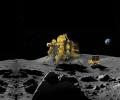
In a boost to the space programme, the government on Wednesday approved the Chandrayaan-4 mission to bring back moon rocks to earth, to send a spacecraft to orbit planet Venus and to expand the Gaganyaan project to build an Indian space station.
'The solution is to replace, clean up, retest and proceed.' 'There is nothing to worry about if corrected.'

ISRO to launch a 6,500 kg communication satellite built by the US, marking a significant milestone in the Indian space program after the successful launch of the NASA-ISRO NISAR mission.

The sesquicentenary of 'Vande Mataram' was the overriding theme of the ceremonial event held at the Vijay Chowk and presided over by President Droupadi Murmu, who arrived at the venue in a traditional buggy to the sound of bugles, adding a ceremonial grace to the occasion.
ISRO chairman G Madhavan Nair said Chandrayaan-2, to be undertaken by 2010, will have a proper lander, which would land on the lunar surface and try to explore the surface in far more detail.
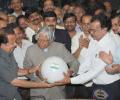
It was former President A P J Abdul Kalam's idea to paint the Indian flag on the Moon. Minutes after his dream was realized, a relieved Kalam is seen holding a globe with the Tricolour on it. ISRO chief Madhavan Nair is also seen.
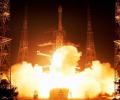
Indian Space Research Organisation is gearing up for one of its busiest times with seven more launches planned this financial year, even as India's first human spaceflight remains scheduled for 2027, its chairman V Narayanan said.

The Indian Space Research Organisation (ISRO) has received approval for the Chandrayaan-5 mission, which aims to study the Moon's surface using a 250kg rover. The mission will be conducted in collaboration with Japan. This follows the success of the Chandrayaan-3 mission, which achieved a soft landing on the Moon's South Pole in August 2023. ISRO is also planning to establish a space station, Bharatiya Space Station, in the near future.

An entire nation waited, praying and hoping fervently, as the countdown to touch down on the moon wound to a slow close on Wednesday with many thousands gathering in schools, places of worship and elsewhere and scientists doing last minute checks to ensure Chandrayaan-3 makes a soft landing on the lunar south pole.
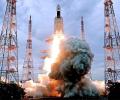
'You can observe a lot of things from space.' 'Another thing is communication, in real time, especially in war-like situations.' 'During Operation Sindoor, we could play our part well.'

At least four babies, three boys and a girl, who were born in the Kendrapara district hospital here on Wednesday evening were named so by their overwhelmed parents.

The soft landing of the spacecraft is planned for late August. The mission is expected to be supportive to future interplanetary missions.

Here is the timeline of the moon mission as undertaken by the Indian Space Research Organisation.
A group of students from Coimbatore have designed a robot that is capable of conducting specific lunar missions.

Here's a quick look at all the winners of the 83rd edition of the Golden Globes.
India's ambitious unmanned lunar mission `Chandrayan' is likely to soar into the skies in the second week of October, Indian Space Research Organisation Chairman G Madhavan Nair said on Wednesday."The satellite integration is almost complete. And we would be entering the thermovac in about a week's time. It takes about 45-50 days for the launch after thermovac, after which we would declare the date. The earliest is October," he said.
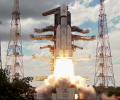
New data from India's Chandrayaan-3 mission suggests that ice might be present at more locations on the Moon's surface than previously believed. The study, published in Communications Earth and Environment, analyzed temperature data collected by the ChaSTE probe onboard the Vikram lander. The researchers found that significant variations in surface temperatures can influence the formation of ice, with slopes angled away from the Sun potentially providing favorable conditions for ice accumulation. The findings have implications for future lunar exploration, suggesting that water-ice resources could be more accessible than previously thought.

The next operation - reduction of orbit- will be done at 11 PM on Sunday, ISRO added.

Amit Kshatriya, a decorated Indian-American and NASA veteran, has been appointed as NASA's new associate administrator, marking a significant step in the agency's exploration efforts.
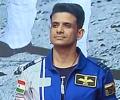
Axiom-4 mission to the International Space Station, piloted by Indian astronaut Group Captain Shubhanshu Shukla with three other crew members, has been delayed and will now be launched from the Kennedy Space Centre in Florida on June 8 at 6:41 pm IST.
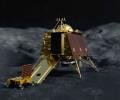
Conducting in-situ scientific experiments is underway. All payloads are performing normally, ISRO said.
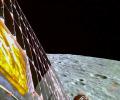
Chandrayaan-1, India's first mission to the Moon, was launched on October 22, 2008 from Sriharikota spaceport in Andhra Pradesh.

Film folk like Akshay Kumar, Chiranjeevi, Jr NTR and Sunny Deol congratulated the country and the Indian Space Research Organisation (ISRO) on the historic achievement of Chandrayaan-3's landing on the Moon.

On Friday, July 14, India launched its ambitious third lunar mission Chandrayaan 3, eyeing a rare feat in moon exploration.
After the successful landing of Chandrayaan-3 on the Moon on Wednesday, August 23, Bollywood has joined India to laud ISRO (Indian Space Research Organisation) and its team for the historic mission.

Russia's state space corporation, Roskosmos, according to the Reuters report, said it had lost contact with the spacecraft shortly after a problem occurred as it was shunted into pre-landing orbit on Saturday.
 © 2026 Rediff.com - Advertise with us - Disclaimer - Privacy Policy - Sitemap - Feedback - About us - Terms of use - Grievances